
A reconciliation spell is candle work set on two names to reopen contact after a break and soften whatever closed it. It works on love that already existed. It does not create feelings from nothing, and it does not bind anyone against themselves.
I cast these at my altar for people who have a name in a text box they have not sent. What follows is the version I would give a friend who wanted to do it at home: what the work is, how to cast a simple one, how to read the candle when it is done, and what I do differently when someone asks me to cast it for them.
What a reconciliation spell does
It works on the gap between two people, not on either person’s will. When two people split, something closes the door: pride, a hurt that never got named, silence that went on long enough to feel like an answer. The love underneath is often still there. The spell works on what is sitting on top of it.
A proper reconciliation working does three things:
- It softens. Honey is the old material for this. What has gone hard between you, the grudge, the need to be right, is sweetened until it can move.
- It reopens contact. The two names are tied, so the road between you is open again. The first sign to look for is ordinary: a message, a like, a mutual friend mentioning your name.
- It clears the reason. You name what broke, and the candle burns through it. This is the part most home spells skip.
What it does not do matters as much. It does not rewrite someone’s mind. It does not rebuild a relationship that was over on its own terms. And it is not a binding. If the only way to keep someone is to take away their choice, you do not have a reconciliation. You have a hostage.
Reconciliation, love spell or binding: which one you need
People often ask for the wrong working and then decide spells do not work. Here is how I sort it.
| If this is you | The working |
|---|---|
| You were together, it broke, and the love was real on both sides | Reconciliation |
| You want someone to feel something that has not started yet | Love spell |
| You do not need the whole relationship back, you need one message or an unblock | Contact me spell |
| Someone else is in the middle of it | Third party removal first, then reconciliation |
| You want them to feel what they walked away from, and you are not sure you want them back | Regret spell |
| You want to stop hurting more than you want them back | Cord cutting |
That last row is not a trick. Sometimes a request for reconciliation is really a request for the pain to stop. Cord cutting does that more kindly, and it leaves the door where it is.
Before you cast: three honest questions
Did it end, or did it pause? A break of weeks, where contact has gone cold rather than gone, is the easiest ground for this work. A break of months, or one where you have already reached out and been met with silence, is heavier. It still moves, but it needs the reason cleared before the call goes out.
What closed it? Name it in one or two words. Pride. Distance. Their family. The argument about moving. You will carve this into the candle, and the clearer you are about it, the cleaner the burn.
Do you want them back, or do you want to stop hurting? Answer this one honestly, on your own, before you light anything. Both are fair. They are different workings.
One more thing, said plainly. If they left because they were afraid of you, or they asked you not to contact them, this is not the spell. I will not cast it in that case, and I would ask you not to either.
How to cast a simple reconciliation spell at home
You need one candle, honey, red cord, paper and a pen, and about two hours when nobody will interrupt you.

What you need
- One red or pink candle. A chime candle is ideal because it burns down in about two hours, which is one sitting. A small taper works too.
- Honey. A spoonful in a saucer or a small jar.
- Red cord or thread, about the length of your forearm.
- A square of plain paper and a pen. Brown paper is traditional. Any unlined paper is fine.
- Something to carve with. A pin, a nail, the tip of a small knife.
- A fireproof plate on a clear surface, away from curtains, shelves and pets.
1. Write the petition
Write their first name three times, one under the other. Turn the paper a quarter turn and write your own first name three times across theirs, so the names cross. Crossed names are the oldest way of saying these two belong in the same place.
Around the names, write one sentence of what you want, in the present tense, as if it has already happened. Keep it about the two of you, not about controlling them. We speak again, and what broke between us softens. That is enough. Longer petitions do not work better. They usually just leak the worry into the work.
2. Sweeten it
Fold the paper toward you, once and then again. Folding toward yourself is how you draw something in. Dip a finger in the honey, touch it to the folded paper, then taste the honey yourself and say their name. The old words are as this honey is sweet to me, so you will be sweet to me. Your own words are better if you have them.
3. Carve the candle
Near the top, carve both first names. Near the bottom, carve the word for what broke, the one from your honest questions. The flame reaches your names first and the reason last, so the candle works down through the two of you and burns the reason away at the end.
4. Tie the cord
Wrap the red cord around the folded petition and tie three knots: one for you, one for them, one for what you are rebuilding. Set the petition under the fireproof plate, and stand the candle on the plate above it. The cord and the paper stay out of the flame. They are the tie, not the fuel.
5. Light it and let it burn
Light the candle, say both names and your sentence once, out loud, and then stop talking. Stay in the room. Watch it, because what it does is the answer you will read later. If you have to leave, pinch or snuff the flame rather than blowing it out, and relight it when you are back. Never leave a candle burning alone.
6. What to do with what is left
When the candle has burned down, gather any leftover wax, wrap it with the tied petition in a piece of cloth or paper, and keep it somewhere near where you sleep. Keep it until you have your answer. If they come back, keep it. If they do not, bury it and let it go.
How to read the candle after it burns
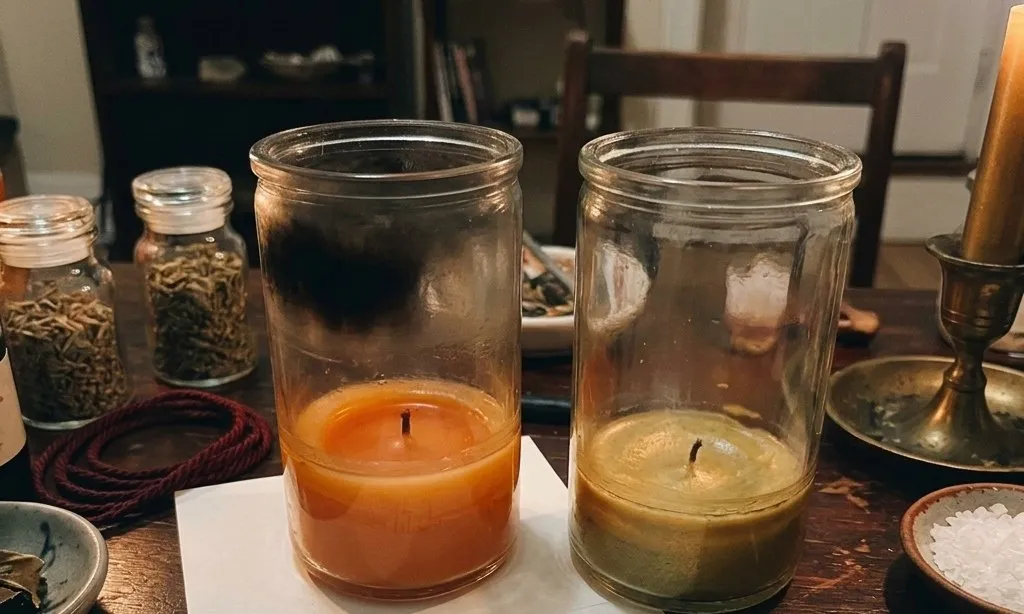
The candle tells you how much resistance there is, not whether they love you. Before you interpret anything, write down what you saw: how the flame stood, where the wax went, what the smoke did. Then read it. This is the same table I use for every report I send.
| What you see | What it means for a reconciliation |
|---|---|
| Tall, steady, bright flame | The road is open. Little resistance. |
| Low, weak flame that barely holds | The reason is heavier than it looks. |
| Flame that jumps, dances or lies down | A lot of movement, but it is contested. Someone else is in it, or they are torn. |
| Flame that splits in two | A second person or a second force in the situation. |
| Crackling or spitting | Talk. Messages, a conversation, someone mentioning your name. |
| Black smoke or soot near the top only | Resistance at the start that burned through. |
| Soot all the way down | Resistance through the whole working. The reason is still standing. |
| Wax running down one side | One of you is pulling harder than the other. |
| An even pool all around | Balance. Neither of you has the upper hand. |
| Burns down to nothing | Closed cleanly. |
| Unburned wax left at the bottom | Part of it is still standing. |
| Goes out on its own | Blocked for now. It needs a second go, not a bigger candle. |
A bad burn is still a reading. A candle that fights is telling you what you are up against, and that is worth knowing before you spend the next month waiting.
How long a reconciliation spell takes to work
I read timing from the burn, not the calendar, and I do not give dates. A clean, steady burn points to movement within one lunar cycle, and the second week is usually where it shows. Heavy soot or a candle that goes out says the reason is still standing, and a second working on that reason comes before anything else.
While you wait, do less than you want to. Do not send the second message or check their profile every hour. Chasing right after the work tends to close what it just opened. Carry on with your life, keep one honest message ready, and when they reach out, answer warmly and plainly, like someone who was doing fine.
When I cast it for you
The method at my altar is the one you just read. Both names crossed on the petition, honey, red cord, the candle carved with what broke and burned through the same day. What changes is what you get back.

You get a photograph of your candle after the burn, and a written report: what I did, what the candle did, what I read in it, what to do this week and what to watch for. If the road looks closed, the report says so, because you deserve to spend the next month on something real.
- Single Candle if the break is fresh, weeks not months, and contact is only cold.
- Double Casting if it has been months, or there is silence you have already tried to break. The first candle clears the reason, the second calls them back.
- Forever and Lasting if you want the road held open across a full lunar cycle while they come round in their own time.
You send first names and roughly how long it has been since you spoke. No birth dates, no charts, no story unless you want to tell it. I do not guarantee outcomes. Nobody honest does. I do the work properly, and I tell you the truth about how it burned.
Choose your reconciliation casting, or read the full listing first.