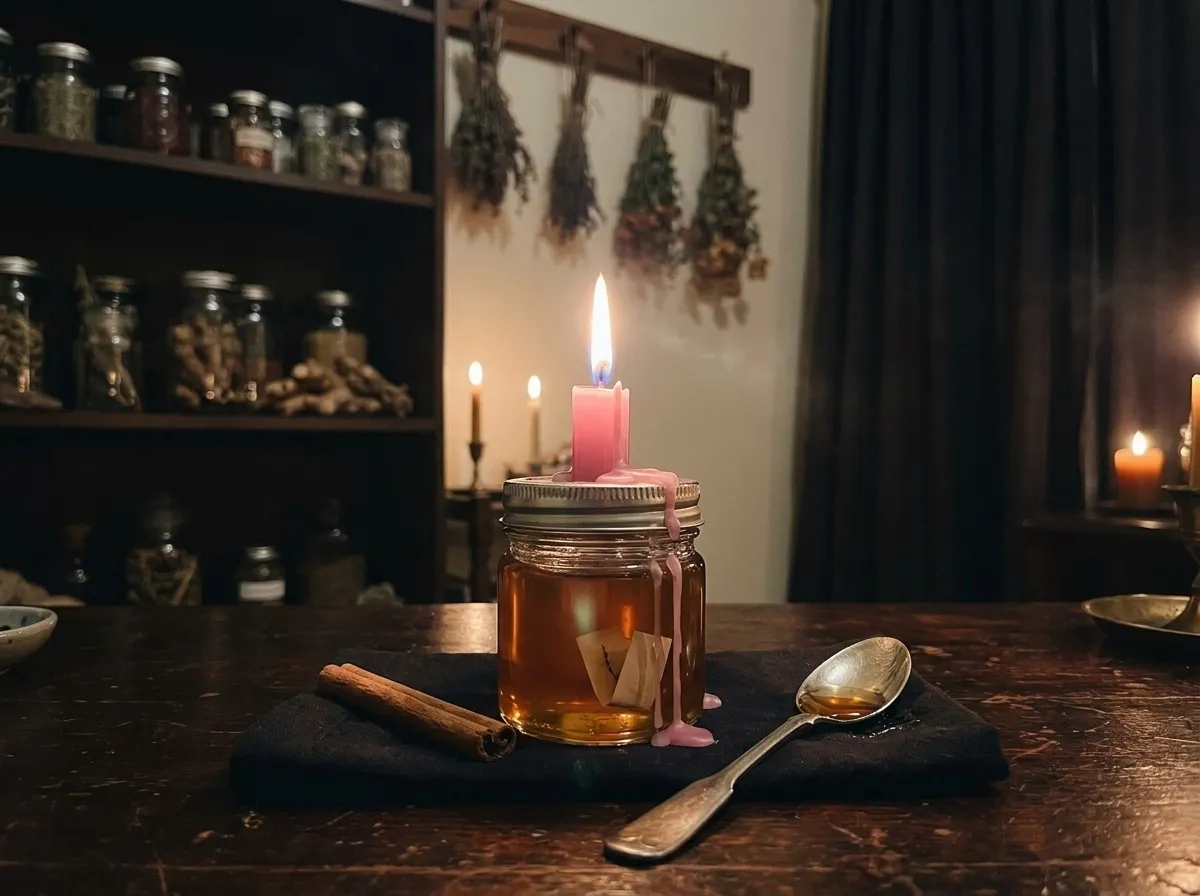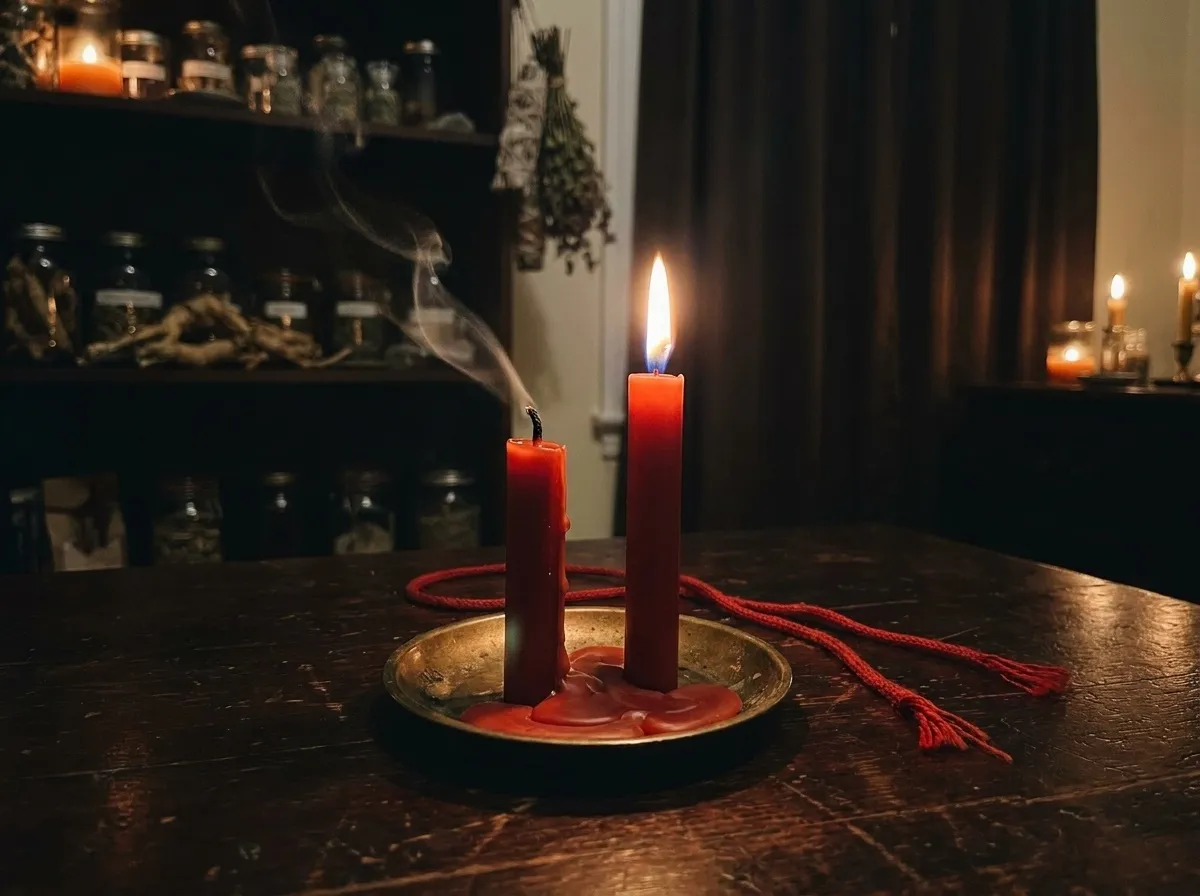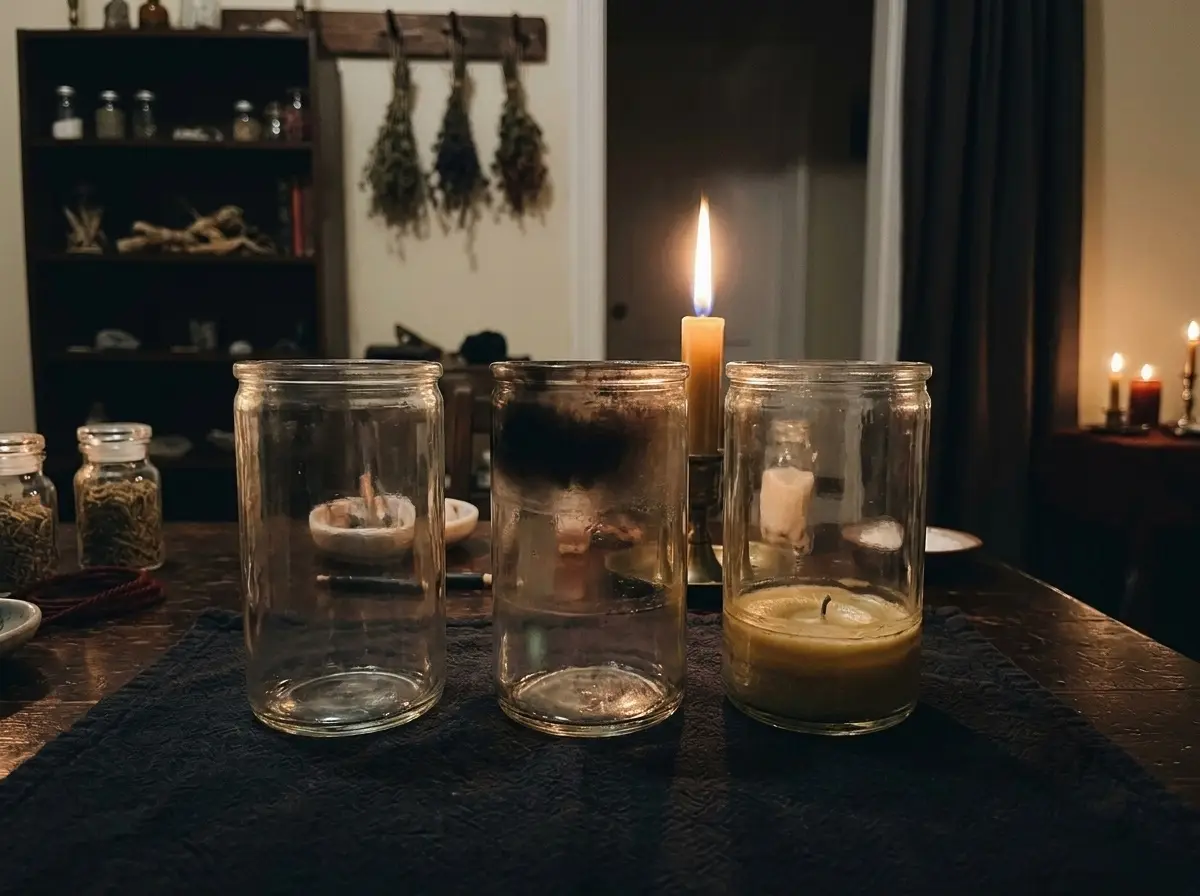
The glass is in front of you with a black smear up one side, and you want to know what it means. How to read a candle burn comes down to four things in a fixed order: the flame while it burned, the smoke, what stayed on the glass, and what the wax did. Before any of them you rule out the room. A draft, a long wick and cold wax each fake a sign, and most of the photographs sent to me asking what a candle meant are photographs of physics.
This is the reference every other guide on this site points to, so it is long on purpose: the room, the flame, the soot, the wax, the timing, the full table, the home method, and what a bad burn means for the work.
How to read a candle burn: the order I take it in
Room, flame, smoke, glass, wax, time, then all of it together. I read in that order because each part checks the one before it. A tall flame with soot down the whole glass is a different burn from a tall flame and clean glass, and the wax at the end decides between a working that finished and one that only looked good.
Two rules before any of it. Write down what you saw before you decide what it meant, because the eye edits fast and a notebook does not. And read for resistance, never for feeling. A candle tells you how much is standing on the road between two people and where, never whether someone loves you. One sign never makes a reading.
Is it a sign, or is it the room?
This is the part the charts leave out, and it is what makes a reading true. Before I light anything I close the room and check it.
- A draft. A vent, a window, a door that does not quite close, a fan in the next room. A draft makes a flame dance, lean, flare and gutter, and none of it is about your ex. Check with the back of your hand at table height.
- The wick. Too long, and you get a tall flame, black smoke and a mushroom of carbon on the tip. That cap is maintenance. A quarter inch, every time.
- The wax. Cheap paraffin soots whatever you asked of it, and scented candles soot worst.
- The cold. On a cold table a candle tunnels down the middle and leaves wax on the walls. That is temperature. Warm the glass in your hands first.
- The glass. Tall narrow glass starves a flame of air near the bottom, so it goes low and smoky at the end no matter what. I know what each of my glasses does empty, which is the only way to know what it is doing full.
- The dressing. Herbs pressed into the wax catch and flare when the flame reaches them. A flare over a pinch of cinnamon is cinnamon.
What does it mean when a candle flame is high, low, blue or dancing?
The first ten minutes and the last ten tell you most of it. In between a flame settles and tells you less, so watch the start and the end and let the middle burn. Staring is its own kind of draft.
Height. Tall and steady is the burn I most want to photograph: the work is taking, the road is open. Low and small, with the wick trimmed, is weight on the work. Often the other person is tired, closed or not ready, and sometimes it is you. A flame that drowns, sinking into its own pool until it is a blue bead, is a work that cannot keep itself lit, and the pool is usually the cause.
Color. Blue at the base is normal, and blue climbing higher or holding for a long stretch is something else in the room with the work; I note it and build nothing on it. A red, smoky flame is a wick problem or heavy resistance burning off; the soot afterwards tells you which.
Movement. Leaning, in a still room, means pulled: I set the names the same way every time so I can read which way. Dancing, jumping, swaying is a lot of movement around the work and some of it unsettled, often the other person pulled two ways. Flickering fast and small is nervous resistance, lighter than a low flame and quicker to clear. Splitting into two flames is two people or two directions; in love work it can be a second pull.
Sound. Popping and crackling is talk: your name in someone’s mouth, or an argument about you. Hissing is a wet wick or the dressing burning off.
Lighting and going out. Hard to light is work that does not want to start, and I ask why before I force it. Going out on its own in a still room is a wall. I relight once. A second time, I write it down and I tell you.
Smoke. Black smoke with a trimmed wick and good wax is something burning off: a block, a hold, somebody’s resistance. Black at the start that clears is the best version; black that comes and goes is a situation changing its mind. Thin white smoke is clean. The direction it goes when snuffed is read the old way, toward you a yes, away a no, and I build nothing on it because a breath moves smoke. Smell matters more: sweet is a clean finish, acrid at the end is something that went out fighting.
Black soot on a candle: what it means and where it sits
Soot is the part I trust most, because it stays. Black soot on good wax is the record of resistance, and where it sits on the glass tells you when it happened. White or gray soot, rare and more a dusting than a smear, I read the way I was taught: help in the room, or something already cleared. I note it and build nothing on it.
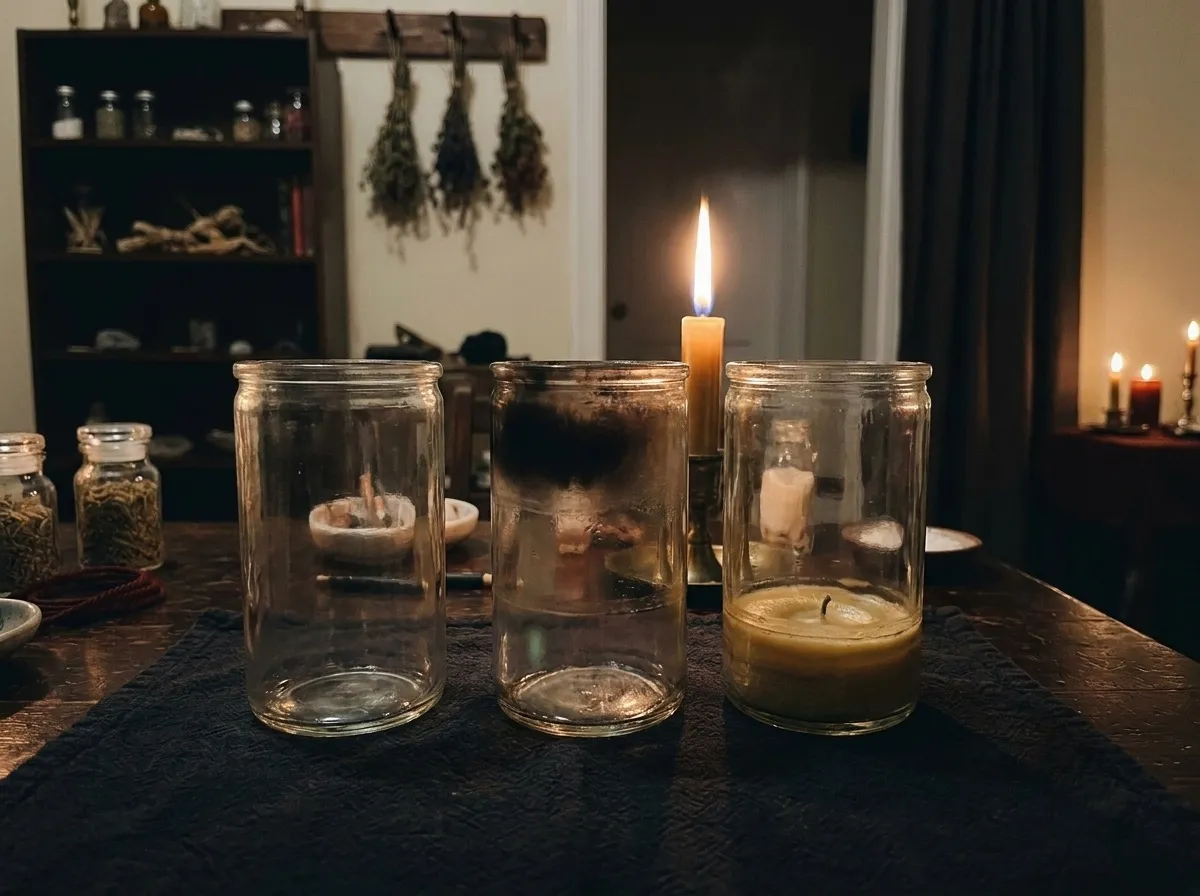
- Clean glass top to bottom. No resistance worth the name. The work went through.
- Soot at the top only. It fought at the start and cleared. Common in contact and reconciliation work, where the first wall is pride.
- Soot at the bottom only. It got harder as it went. Something pushed back once the work was moving, and I usually set a second candle read from this one.
- Soot on one side. Resistance from one direction. With the names set the same way every time, the side tells you whose hold it is.
- Heavy soot all the way down. Fought the whole way. The photograph goes to you anyway and the report says this is a working I would cast again, with a cleansing first.
- Streaks rather than a smear. Resistance that flared and died repeatedly. Somebody changing their mind.
The candles I burned this autumn taught me again how often top-only soot turns into a clean lower glass. The first wall is the one most people never get past, and the candle does.
What does candle tunneling mean, and what about a wick that drowns?
Tunneling is the candle boring down the middle and leaving a wall of wax around the wick. On any glass candle the first burn sets the memory: if it was short or the room was cold, the pool never gets wider than it did that night. Rule that out. In a warm still room with a full first sitting, a tunnel is work held in, and the thing holding it is nearly always the person who lit it, still checking the phone.
A wick that drowns is the other side of the same thing. The pool gets deep, the wick gets short, the flame sinks to a blue bead and goes out. In a working, it is a petition too heavy for the candle: too many names, too many asks, a paragraph where a sentence belonged.
Wax running down one side. The work leaning that way. Toward your name is the pull coming to you. Toward theirs is the pull going to them, the point in some workings and a warning in others. Down the back, away from both, is distance for now.
Wax climbing the glass and staying as a wall. Resistance that hardened. A wall of wax and a wall of soot on the same side is a solid no from that direction.
Leftover wax at the bottom. A thin film is nothing. A thick ring is part of the petition that did not burn, and the work is unfinished. A chunk with the wick still standing in it is a working that stopped itself; I do not relight that one, I set a second candle from what the first showed.
Shapes in the pool. People send me hearts and faces. I do not read them. Wax looks like things the way clouds do.
Cracked glass. Rare, and I take it seriously. In protective and return to sender work it is traditionally the glass taking the hit for you, and the work is done. In love or drawing work it is a stop. Either way the glass leaves the house and is never reused.
The remains. For drawing work I wrap any wax with the petition in cloth and keep it near where I sleep until the answer comes. For cutting and sending back, the remains leave the house the same night, into trash away from the property or buried off your ground.
How fast should a spell candle burn, and in what order do things happen?
A chime candle burns about two hours and that is one sitting. Fast for the candle and the glass is quick work: it takes, and it may not hold. Slow is resistance, and a slow clean burn is a hard situation moving the right way. Uneven, fast then slow, is a situation that changed while the candle was lit. I write down the time it changed, and more than once someone has told me afterwards what happened at that hour.
The order matters as much as the parts. Hard to light, soot at the top, then tall and clean to a finished pool is a working that met a wall and went through it, a better report than a candle that lit easily and left half its wax. Clean start, soot low on their side, then a drowning wick found the real block late: second candle, on the block alone.
How to read a candle burn: the full table
Rule out the room first. Then find what you saw.
| What you see | What it tends to mean | What I do next |
|---|---|---|
| Tall, steady, bright flame | Work taking, road open | Nothing. Let it finish |
| Dancing or swaying, no draft | Unsettled movement, often them pulled two ways | Note which way it leans |
| Flame splits in two | Two people or two directions | Look for a third party before casting again |
| Popping, crackling | Talk about you, an argument | Expect your name in someone’s mouth this week |
| Goes out, still room | A wall | Relight once. Twice, believe it |
| Soot top only | Fought at the start, cleared | Good. Watch for the first signs |
| Soot bottom only | Got harder as it went | Second candle read from this one |
| Soot one side | Resistance from that person | The side tells you whose hold |
| Soot all the way down | Fought the whole way | Cleansing, then cast again |
| Tunnel, warm room, full first burn | Work held in, usually by checking | Stop checking. Second candle after the cycle |
| Wax runs toward your name | Pull coming to you | Good. Do less |
| Wax climbs and walls one side | Hardened resistance | With soot on the same side, a solid no |
| Thick ring at the bottom | Unfinished | Second sitting |
| Cracked glass | Hit taken, or a stop | Out of the house. Protective: done. Drawing: stop |
How to read a candle burn at home, step by step
You will do this better than any chart, because you were in the room. The steps make the candle readable before you light it.
What you need
- One chime candle in the color of the working, unscented, from a maker you trust. Cheap wax reads the factory.
- A glass you know, or a plain fireproof plate. Burn one plain candle in a new glass first, no petition, so you know what the glass does on its own.
- A pin and your petition, written and folded before you sit down.
- Matches, a snuffer or a spoon, scissors for the wick.
- A notebook and a pen, and your phone for one photograph in the morning.
- A still room: door closed, vents off, nothing above the flame, pets out, two hours.
1. Set the room before the candle
Close the door, turn off the vent, check for draft with the back of your hand. Warm the glass if the room is cold. Decide which side is your name and which is theirs, and keep it the same every time.
2. Trim the wick and dress the candle
A quarter inch of wick. Dress and carve as the working asks, press the herbs lightly so they do not pile on one side, and set the candle over the folded petition.
3. Light it, say it once, and watch the first ten minutes
How many matches it took. How the flame stood when it settled. Whether it leaned, and which way. Write that down now, in one line.
4. Leave the middle alone
Stay in the room, do something ordinary, look up every so often. If you must leave, snuff it and relight when you are back. Never blow it out.
5. Watch the last ten minutes
The end is where the wick drowns or the flame fights. Note the time if anything changes, and listen.
6. Photograph the glass in daylight
Next morning, before you clean anything, from the side and from above. Soot and wax are easier to read with the drama gone.
7. Write three lines and match them against the table
Flame, soot, wax, then one line of what they agree on. Date it. Signs tend to arrive in the second or third week, and the notebook is how you know they were signs.
What does a bad burn mean for the work, and when do I re-cast?
Less than people fear. A bad burn is the candle telling you where the wall is, which is more than you knew before you lit it. It is never a curse and rarely a failure. Sometimes the answer is a cleansing and a second candle. Sometimes it is a different working. And sometimes it is a no, said in soot, and the kindest thing I can do is pass it on.
When I cast for you, the photograph comes whatever the glass looks like, and if it burned badly the report says so in the first line and then says what I would do about it. If a second candle on the reason alone would help, that is a new order at the same price on the page, and you can say no. The thirty days are for the work itself: if what comes back is not a photograph of your candle and a written reading of it, I re-cast it or refund you within thirty days. I would rather lose the sale than pretend about a candle.
If three candles across a cycle have all said no, believe them. A cord cutting gives you your attention back more kindly than a fourth candle.
The mistakes that fake a reading
- Reading a draft. The commonest false sign on earth. Door, vent, window, fan, breath.
- Reading an untrimmed wick. Tall flame, black smoke, carbon cap. That is maintenance.
- Scented or cheap candles. You cannot read resistance through perfume.
- Blowing it out. Scatters the work and the soot. Snuff or pinch.
- Reading someone else’s photograph. Without the room, the wick and the first ten minutes, a photo is half a reading.
When the candle is the wrong tool
A candle reads resistance on the road. For any other question, use something else.
| If what you need is | Use |
|---|---|
| To know what they feel, before any work | A written reading |
| Slow sweetening with no single night to read | A honey jar spell, fed weekly |
| The road itself, after three burns say no | Will my ex come back, then a cord cutting |
| A second flame that keeps appearing | Third party removal first |
| Heavy soot in the first inch of every candle you light | Cleansing, then signs someone put a spell on you |
When I burn it and read it for you
The method at my altar for a love working is a red candle dressed and carved with both first names and what stands in the way, the petition under it, red cord tied, burned through in one sitting while I sit with it, in a checked room with a trimmed wick and the names set the same way every time. An order in before 6 pm ET is set the same night.

- Single Candle, $19, when something already exists between you and it needs heat.
- Double Casting, $29, when they have gone quiet or there is distance you did not choose: two candles in one night, the second set from what the first showed.
Same Day Rush is $9 more. First names, yours and theirs, are what you send, with a photo if you like. Birth dates and charts are not part of candle work, and the story is yours to tell or not. What comes back is the photograph and the written report: the flame, the soot, the wax, what that means for you, and what to do this week. Reply with questions and I answer. Most people notice the first signs in the second or third week, and the full turn within three lunar cycles. I cannot promise an outcome, and nobody honest can. Re-cast or refund within thirty days if what comes back is not what I have described. The checkout on this site takes card, Apple Pay and Google Pay, and your statement shows SABLEWITCH.
Choose your love spell casting, or read the full listing first.
Paying someone else to do it? Read how to tell a real spell caster from a scam and what spell casting costs first, then compare it with the work I do by hand.