Someone in your life has gone sharp with you, and you want them soft again without a scene. A honey jar spell is slow sweetening work: two names on paper, in honey, in a jar with a lid, and a small candle burned on that lid once a week. It changes how one person is toward another over weeks. It is a thaw, with no pull in it, and it fails most often in the hands of people who wanted it to be a pull.
I have made jars for lovers, for a landlord, and for a sister who had stopped answering, and none of them did anything in the first fortnight. This page is the whole life of a jar: who it can sweeten, what goes in it and why, how to build it and keep it fed, how long it takes, what the lid tells you week by week, the mistakes that stall it, and what to do with the jar when you are done, which nobody seems to tell you.
What does a honey jar spell actually do?
It sweetens the way a named person is toward you, slowly, for as long as you keep feeding it. The honey holds the two names in one place and keeps them sweet. The weekly candle is you returning your attention to that sweetness. Nothing in the jar reaches out, calls anyone, or moves anyone. It changes the temperature in a room you are both already in.
That is why it comes out of kitchens rather than temples. Honey jars are American rootwork, household work, done with what was in the pantry: honey, sugar, syrup, molasses. There is nothing on my altar for a jar that my grandmother did not also have on a shelf. The jar does one thing, which is to make the next conversation a little softer than the last one.
The distinction that matters is between sweetening and pulling. Sweet work changes how someone is with you. Pulling work brings someone to you. A jar does the first. For the second you want fire, which is why my own work at the altar is candle work.
Who a jar can sweeten, and who it cannot reach
The one question to answer before you buy honey: does this person already have a reason to think of me? If yes, a jar has something to work on. If no, there is nothing in the jar for the honey to hold.
| The person | Will a jar sweeten them? |
|---|---|
| A partner who has gone short, critical, distant, and is still here | Yes. This is the gentlest work there is on a relationship you want to keep. |
| An ex who is still in your life somehow, cold or sharp | Yes, slowly. If you want more than warmth back, a reconciliation spell comes first and the jar after. |
| A boss, a coworker, a landlord, a mother in law | Yes, and it is one of the oldest uses. White candle, one line, weekly. |
| Someone new and warm who needs a push | A jar will do it slowly. A love spell candle on the lid does it faster, and the jar keeps it. |
| Someone you have never spoken to | No. Nothing to sweeten. A glamour spell on you is the honest working. |
| Someone who has blocked you entirely | Not yet. Open the channel with contact me work and set the jar after. |
| Someone who said no and meant it | No. I will not set it and I would ask you not to. |
If you are in the first three rows, a jar is the right tool. Everyone else needs a different working first, with the jar to keep what it opened.
Honey, sugar or syrup, and what else goes in
Honey, if you have it, because it stays thick, holds the paper where you put it, and keeps working for a month without being touched. Sugar is the quick version: it sweetens fast and dissolves into the paper by the third feeding, which suits a short job like one difficult meeting. Syrup and molasses are for the stubborn ones, the person who has been sharp with you for years, because they are heavy and slow and do not let go.
What else goes in depends on who the jar is for, and less is better. A pinch of dried rose petals for a lover, crushed between your fingers so the scent breaks. A bay leaf for a boss, written on with their name, because bay is for being heard. A pinch of cinnamon for anything that needs to move a little faster than honey wants to. Nothing from the back of the spice rack because it smelled nice. Every herb in a jar is a sentence, and a jar full of sentences says nothing.
The jar itself should be small and glass with a metal lid. I wash mine in salt water and dry them in the sun, which is just a way of starting from nothing. A jar that still smells of pickles carries the pickles.
How to do a honey jar spell, from the first candle to the weekly feeding
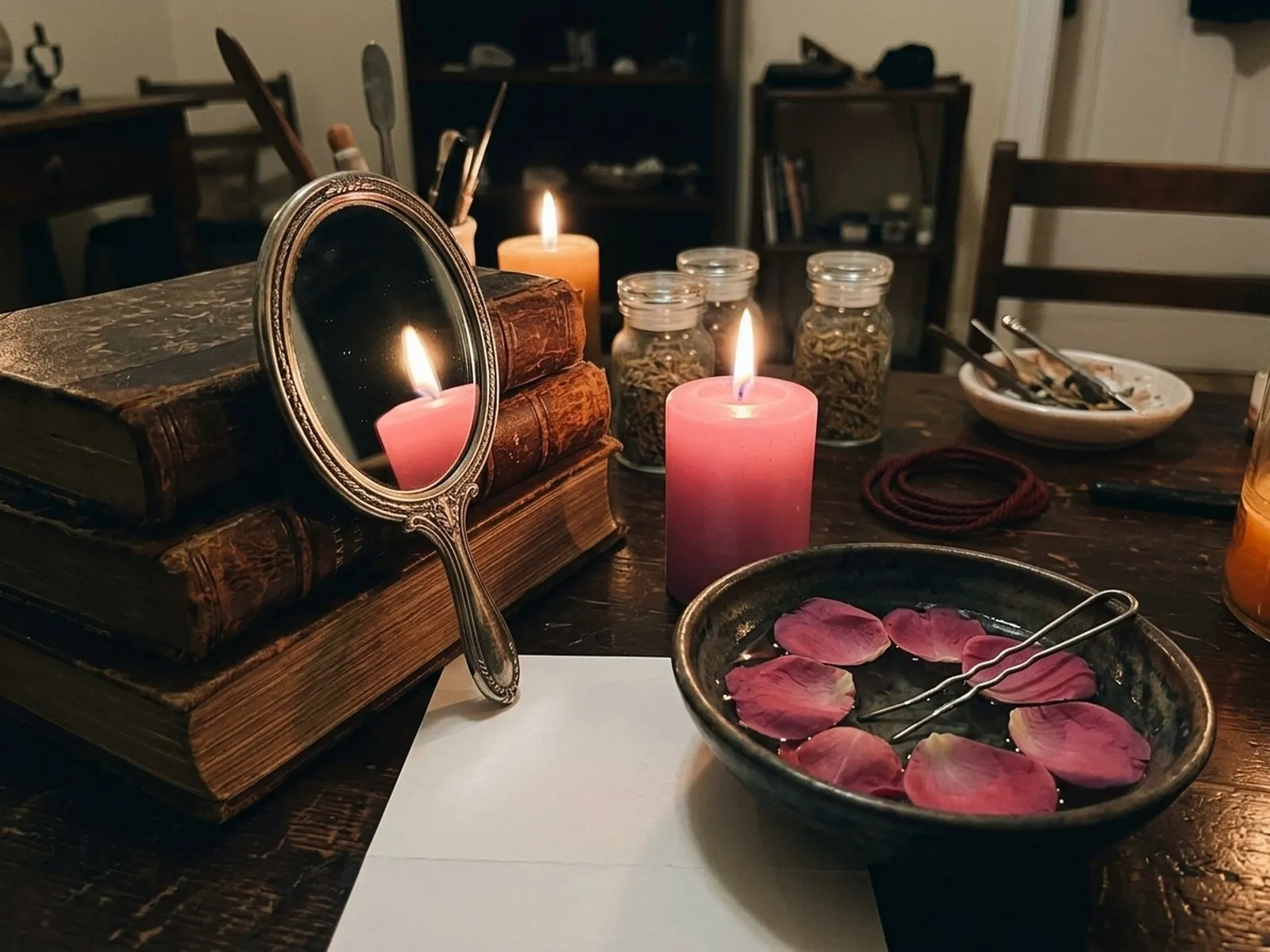
You need a jar, honey, paper, a pen, a small candle and about an hour for the first sitting, then a quarter of an hour once a week after that. This is the version for anyone who has gone cold on you. For the love version, with a red candle, cinnamon and cord, see the love spell guide.

What you need
- A small glass jar with a metal lid, washed in salt water and dry.
- Honey enough to fill it two thirds, or sugar, or syrup, as above.
- A square of plain paper the size of your palm and a pen.
- A small candle for the lid: pink for affection, red for a lover, white for anyone else. Tealights are fine, and you will need one a week.
- Optional: rose petals, a bay leaf, a pinch of cinnamon, one of them and not all three.
- A fireproof plate for the jar to stand on, in a room with the door shut.
1. Write the paper for the person they are
Write their first name three times, one under the other, the name they answer to when a friend calls across a room. Turn the paper a quarter turn clockwise and write your own first name three times straight across theirs, so yours sits on top. Then one line around the names about how you want them to be toward you, in the present tense: You are warm with me and glad when I am near. For a boss: You hear me and you are fair with me. Nothing about what they must do, say or stop.
2. Taste it, and say so
Before anything goes into the jar, dip a finger in the honey and taste it. Say their name and the old line, as this is sweet to me, so you are sweet to me, or your own words. You taste first because the softening starts with the person holding the spoon. Skip this and you have a jar of honey with paper in it.
3. Fold toward you, and put it under
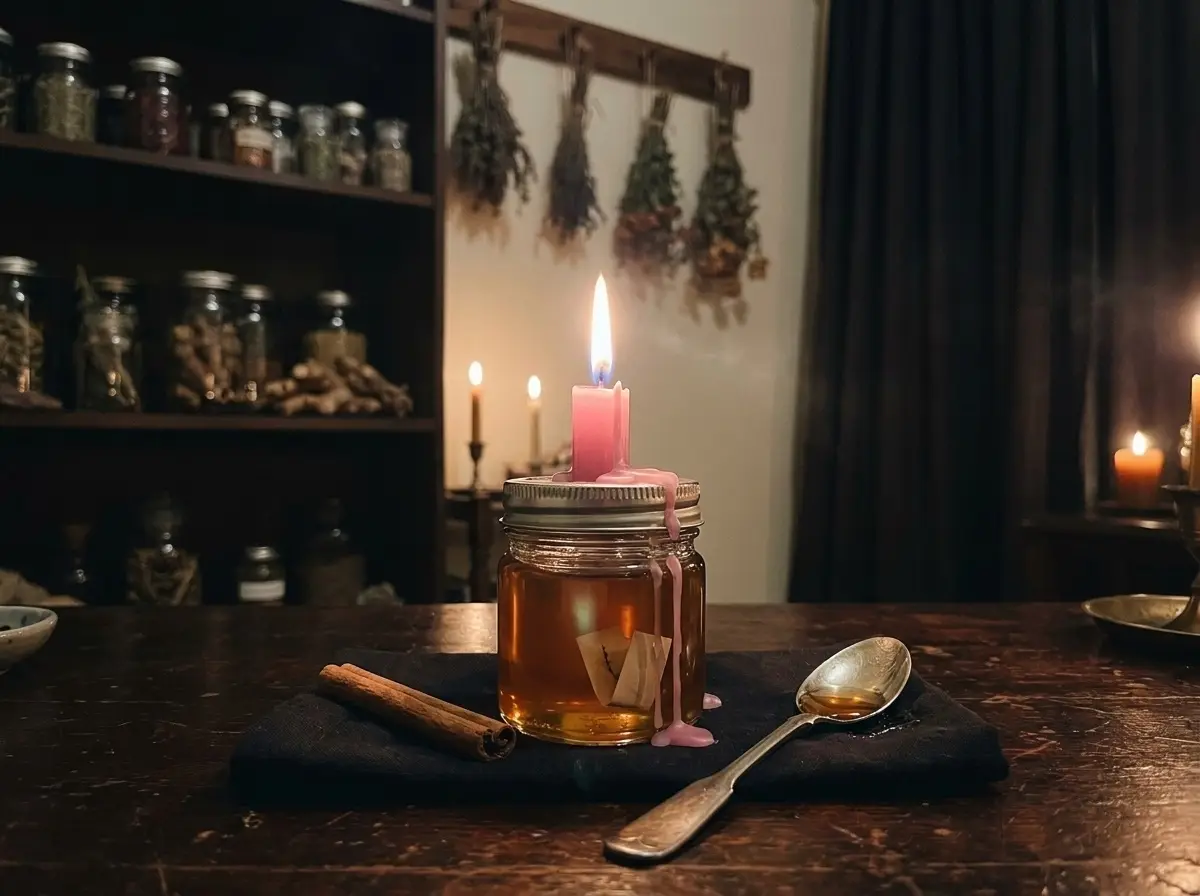
Fold the paper toward your chest once. Lay the rose petals or the bay leaf in the crease and fold it toward you again. Push it down into the honey with the back of a spoon until it is covered, and if you are using cinnamon, drop the piece in now. Wipe the rim. Screw the lid down tight, and it stays tight from here on.
4. The first candle
Warm the base of the candle with a match and seat it in the center of the lid, or set the tealight there in its cup. Light it. Say their name and your one line once, out loud, and stop talking. Sit with it while it burns down, an hour or so for a tealight, and watch the start and the end. If you must leave, pinch it out and relight it when you are back. Never blow it out, and never leave it burning alone.
5. Every week after, on the same day
This is the step that makes a jar a jar. Pick a day and keep it: Friday for a lover, Thursday for work or money. Stand a fresh candle on the cooled wax from last week. Do not scrape the lid. Light it, say the name and the line once, and let it burn out while you do something quiet in the same room. While it burns, think of one real afternoon when that person was warm with you. A real one, with weather in it. That is the thing you are feeding.
6. Where it lives, and what you never do
Between feedings the jar lives somewhere out of sight and out of the damp: a bedroom drawer, the top of a wardrobe. Never the bathroom, never a windowsill in the sun. You do not open it. There is nothing to see and you are letting the work out. If the lid is too thick with wax to seat a candle, set the tealight on the wax anyway. A lid heavy with wax is a jar that has been loved.
How long does a honey jar spell take to work?
Weeks. The first softening usually shows somewhere between the second and the sixth feeding, so two to six weeks of weekly candles, and my rule is three feedings before you judge it at all. The candle work I set at the altar moves faster, with most people noticing the first signs in the second or third week. A jar is built slower than that on purpose.
A thaw runs slowly at the start and quickly at the end, which is exactly the wrong shape for someone checking every morning. People open the drawer at week two, find a jar of honey doing nothing visible, and throw it out. The jar that would have turned at week five is in the bin. If you cannot keep a thing going for six weeks without proof, a candle with a photograph at the end of the night suits you better, and that is a fit, nothing to be ashamed of.
Two things stretch a jar. Feeding it daily, which is chasing in a different coat. And asking it to do a pull, which it cannot. A jar changes the next conversation you were going to have anyway. If there is no next conversation coming, there is nothing for it to change, and you want fire first.
What the candle on the lid tells you week by week
The lid is the record. Each feeding leaves wax, and the way it leaves it is the week’s reading. The grammar of flame and soot is in how to read a candle burn, and these are the things that matter on a jar in particular.
The first candle is the ground. Tall and steady says there is something to sweeten. Low and shivering in a still room says the person is tired of you, or closed, and the jar will be slow. A first candle that goes out, relit once and out again, is a jar I would not set this week.
Wax that runs down the jar toward the side you sit on is the sweetness coming your way. Down the far side is fine on one week, and worth noting if it does it every week, because that is a jar sweetening them toward someone who is not you.
A dark ring under the candle is resistance that week. In the photographs of jars people send me, a dark ring in week two that has gone by week four is the commonest good sign there is, and the one most often thrown out before it clears.
A candle that will not light on the cold wax wants the lid warmed first. Hold your palm flat on it for a slow count of twenty, then seat the candle. If it still will not take, skip the week and think about why.
A candle that tunnels and drowns its own wick is attention that is not landing. Next week, trim the wick shorter, seat the candle off the old center, and spend the hour in the room instead of in the next one.
The signs of a thaw, in the order they come
Ordinary, which is how you know. First, the tone. A message with no edge on it. A greeting at work that is not a sigh. Then they let something go that they would have fought about a month ago. Then something kind, sideways, as if by accident, the sort of thing people say and then look surprised at. Then they start a conversation. Small, about nothing, and from their side. Last, the room is simply easier with them in it, and you notice one evening that you stopped bracing.
What you will not get from a jar is a declaration, a proposal, a dramatic return at the door in the rain. Honey does not do drama. If the warmth comes back and you want more, a candle working goes on top and the jar keeps the ground soft under it. A report I wrote last month ended on exactly that: the candle had opened the road, and something had to keep it sweet while they walked it.
Mistakes that stall a jar, seen from the lid
- Too many names. One person per jar. A jar asked to sweeten your partner, your mother and your boss sweetens nobody, and the lid shows it in wax that runs three ways.
- A page where a line belongs. The paper is a sentence. The history, the terms, what they must say: none of that is sweet, and honey will not carry it.
- A demand dressed as a wish. He will never leave. She stops seeing him. Those are chains. Chains stall in honey and the candle lies down on them every week.
- Sealing it and forgetting it. A jar nobody lights a candle on is a jar nobody is thinking about. It goes quiet.
- Feeding it angry. You cannot sweeten someone while you are furious with them. If you sat down with a list of grievances, wait a week. The jar will keep.
- Scraping the lid clean. The wax is the record and the weight of the weeks. In the jars people photograph for me, the stalled ones almost always have a lid that has been scraped to the metal.
Honey jar with a reconciliation spell, or on its own?
The candle first, the jar after. A reconciliation candle burns through the reason it ended, in one sitting, with fire, and a jar has no fire. What a jar does well is keep the road sweet during the weeks when the other person is coming round and you are trying not to text.
So for an ex after a real break, I would set the reconciliation spell first, with honey and red cord and the reason carved at the base, and start the jar the week after, on the same day each week. For a partner who is still here and has gone sharp, the jar on its own is the kinder tool and the right one. And if you are not sure which you have, a cold spell or an ending, will my ex come back is where I lay out the difference, because a jar set on an ending is six weeks of honey on a closed door.
When the jar is finished
If the relationship is good and ongoing, keep the jar and feed it less often. Once a month is plenty. People keep a jar for a marriage for years, and I think that is a fine use of a Friday evening.
If the work is done and you want the sweetness to stay, bury the jar on your own ground, or put it at the back of a cupboard and leave it. A quiet jar holds what it was given.
If the person is gone from your life, empty the honey into running water or into the trash away from the house, burn the paper, and wash the jar with salt water. Do not keep a jar for someone you no longer want near you, out of sentiment. That is a cord you have not cut, and a cord cutting is the kinder next step.
If you forgot it, nothing bad has happened. A forgotten jar is a stopped jar. Either feed it or clear it.
When I cast it for you
I do not keep jars for other people. A jar needs a hand on it every week, and that hand should belong to the person whose name is in it. What I cast at my altar is the fire the jar does not have: a love candle, both first names crossed on the petition, honey tasted and set, the candle dressed and carved with what stands in the way and burned through in one sitting the same day your order comes in. If the order is in before 6 pm ET, the candle is on the altar the same night. The report tells you how to set your jar the week after.
What comes back is a photograph of your candle after the burn and a written report: what the flame did, where the wax and soot went, what I read in it, and the day to start feeding your jar. Reply with questions and I answer.
- Single Candle for a bond that already exists and wants warming, $19.
- Double Casting for someone who has gone silent, or for a distance that was not your choice: two candles in one night, the second read from the first, $29.
You send first names, yours and theirs. There is no birth date to send and no chart to read, and the story is optional. If the casting that comes back is not what I have described here, I re-cast or refund within thirty days.
Choose your love spell casting, or read the full listing first.
Paying someone else to do it? Read how to tell a real spell caster from a scam and what spell casting costs first, then compare it with the work I do by hand.